
Comprehensive Guide to the Best Open Source POS Systems for Sri Lanka’s SME Digitalization
Sri Lanka’s government has committed to aggressive digitalization through initiatives like the 2026 budget’s e-invoicing mandate, VAT system integration, and linkage of POS machines to the Inland Revenue Authority, as part of broader efforts to achieve a $30 billion digital economy by 2030.[11][12][14] For local shops and SMEs to align with these requirements while maintaining affordability, several world-class open source POS systems offer compelling solutions that combine zero licensing costs with enterprise-grade features.
Top Recommended Open Source POS Systems for Sri Lankan SMEs
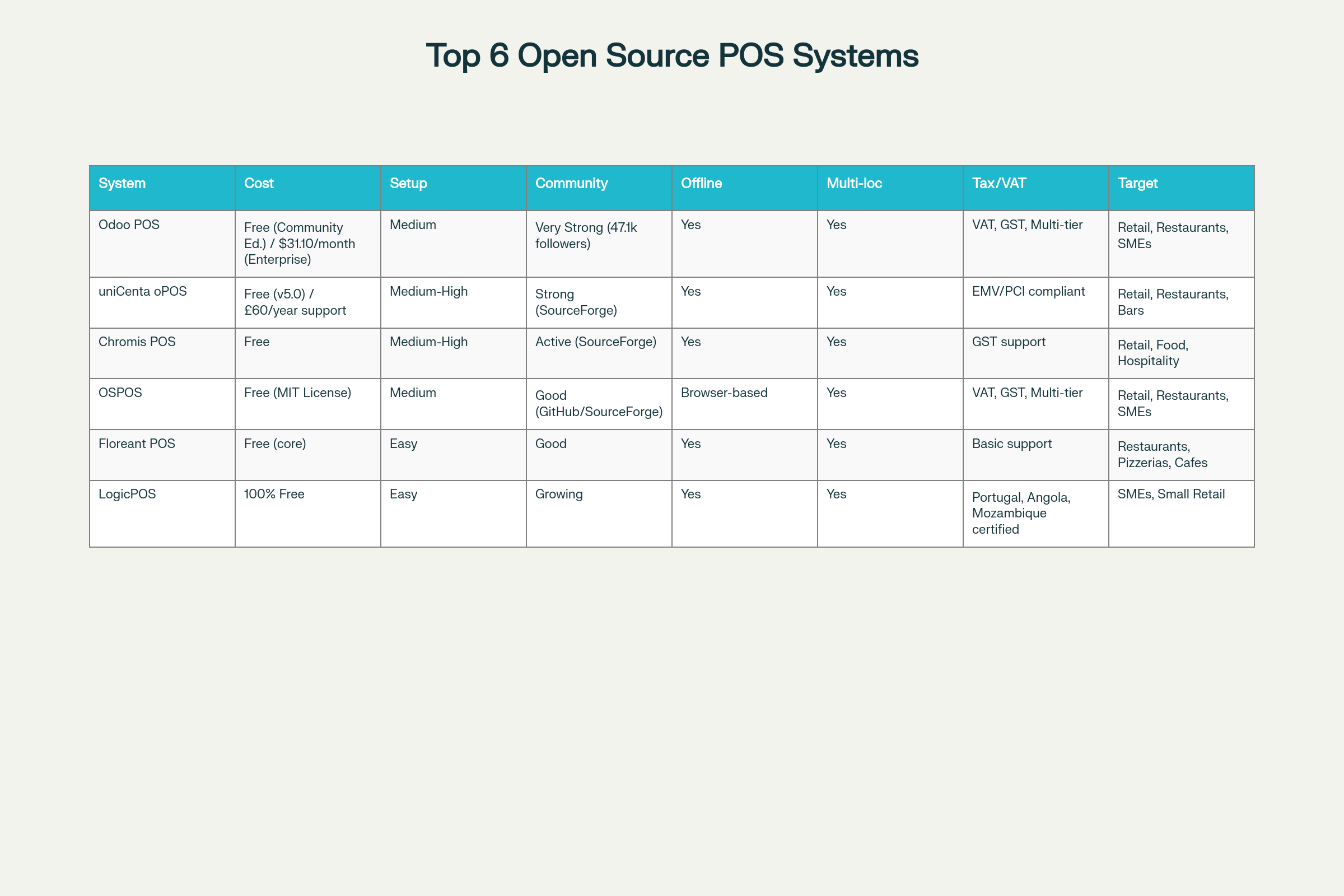
1. Odoo POS (Best Overall for Full Business Integration)
Odoo POS stands out as the most comprehensive solution for SMEs seeking integration with accounting, inventory, and customer management.[44][48] The Community Edition is completely free and open source, though most users deploy the Enterprise version at $31.10/month per user for cloud hosting with automatic updates and support.[18][66]
Key Strengths:
- Unlimited customization through open source code and API capabilities
- Seamless integration with accounting, CRM, and e-commerce modules
- Multi-language support (30+ languages including English and regional Asian languages)
- Offline-capable with automatic synchronization when connectivity restores
- VAT/GST compliance with multi-tier taxation support, critical for Sri Lanka’s upcoming e-invoicing requirements[12]
- Real-time inventory tracking across multiple locations
- Mobile-ready with iPad, Android tablet, and web browser support
Considerations: Requires more technical setup than some alternatives; free tier has limitations on advanced features. However, the learning curve is manageable for tech-savvy operators.
2. uniCenta oPOS (Most Accessible for Retailers and Restaurants)
uniCenta is a commercial-grade, truly free open source solution used by thousands of retailers, bars, cafes, and restaurants worldwide.[2][20] The core version is freely available on SourceForge with full GPL3 source code access, while optional support costs as little as £60/year.
Key Strengths:
- Completely free with no hidden fees or time limitations
- 17-language support including multiple Asian markets
- Proven track record of reliability across 50+ countries
- Advanced inventory management with multi-warehouse, supplier tracking, and purchase order automation
- Cloud and on-premise flexibility allowing businesses to choose their deployment model
- WooCommerce integration for seamless online-to-offline retail operations
- Loyalty programs and gift card systems built-in
- Multi-location, multi-terminal, multi-user architecture
- Comprehensive reporting with 50+ built-in reports
- Offline transaction capability for uninterrupted service during connectivity loss
Best For: Retail shops, restaurants, bars, and hospitality businesses in Sri Lanka seeking a mature, battle-tested platform.
3. Chromis POS (Excellent for Food and Retail with Active Development)
Chromis POS is a completely free Java-based solution actively maintained by a dedicated team, evolved from the OpenBravo/uniCenta lineage.[62][64] Recent updates (version 1.5.4 released April 2024) demonstrate ongoing development commitment.
Key Strengths:
- 100% free and open source with no licensing or subscription costs
- Active development with regular bug fixes and new features
- Strong hardware support including USB printers and standard peripherals
- Kitchen Display System (KDS) integration for restaurants
- Loyalty systems and electronic gift cards included
- CSV product import for bulk data management
- Embedded database migration from Derby to MySQL/PostgreSQL
- Multi-database support for flexibility and scalability
- Community-driven with engagement on GitHub and SourceForge
Best For: Food businesses, small to medium retailers, and technical teams comfortable with Java-based applications.
4. Open Source Point of Sale (OSPOS) (Best Web-Based Solution)
OSPOS is a modern web-based POS system written in PHP with MySQL backend, featuring CodeIgniter 4 framework and Bootstrap interface.[10][24] Completely free under MIT License.
Key Strengths:
- Web-based accessibility from any browser on any device
- Easy cloud deployment with Docker containerization
- Runs on minimal hardware including Raspberry Pi
- Comprehensive reporting with customizable dashboards
- VAT, GST, and multi-tier tax support built-in
- Barcode generation and printing with embedded variable prices/weights
- Multi-language interface
- GDPR compliance and security-focused
- MailChimp integration for marketing
- SMS messaging capability for customer communication
- Offline mode with local data storage and automatic cloud sync
Best For: Tech-forward businesses, multi-location chains, and those seeking cloud deployment flexibility.
5. Floreant POS (Ideal for Food Service and Restaurants)
Floreant POS is a fully free, open source restaurant POS with an intuitive interface specifically designed for food service operations.[4][31] Zero hidden costs or advertisements.
Key Strengths:
- Specialized restaurant features including table management and order tracking
- Ease of setup among the most user-friendly options
- Offline operation requiring only local database on individual machines
- No advertisement and no hidden licensing
- Kitchen printer support and kitchen display integration
- Flexible menu management with customizable categories and modifiers
- Split bills and partial payments support
- Customer database for loyalty and history tracking
- Multi-location capability for restaurant chains
- Excellent community reviews (4.8/5.0 on GetApp)
Best For: Restaurants, pizzerias, cafes, and food service businesses prioritizing ease of use and restaurant-specific features.
6. LogicPOS (Emerging Alternative with Tax Authority Certification)
LogicPOS is a completely free, open source SME billing and POS system with a unique advantage: government tax authority certification in Portugal, Angola, and Mozambique.[58] The software is designed specifically for SME management and reporting needs.
Key Strengths:
- 100% free forever with no premium upsell model
- Tax authority certified in multiple countries, demonstrating compliance standards
- Hardware agnostic – works with any desktop computer and printer
- Focused on SME requirements with emphasis on daily billing and financial management
- Multilingual interface
- Community-driven development with active GitHub repository
- Growing global adoption in developing markets
Best For: SMEs seeking government-recognized compliance, businesses in emerging markets, and operators preferring simplified interfaces.
Alignment with Sri Lanka’s Digital Transformation Requirements
Sri Lanka’s government has outlined a three-phase e-invoicing and POS integration strategy:[12][14]
- Phase 1: Integration with exporters and businesses using ERP systems via API
- Phase 2: Expansion to all VAT-registered taxpayers
- Phase 3: Real-time POS integration for transaction recording and VAT compliance
Recommended systems that support this trajectory:
| Requirement | Best Option | Alternative |
|---|---|---|
| E-invoicing XML format support | Odoo POS, OSPOS | Floreant POS |
| Real-time inventory for VAT compliance | uniCenta, Odoo POS | Chromis POS |
| API capabilities for government integration | Odoo POS | uniCenta |
| Multi-location chain support | uniCenta, Odoo POS | OSPOS, Chromis POS |
| Offline reliability (crucial for Sri Lankan connectivity) | Floreant, Chromis, uniCenta | OSPOS (browser-based) |
Why Open Source is Critical for Sri Lanka’s SME Sector
- Cost Elimination: With 263,000 SMEs at risk of collapse due to economic pressure,[11] zero licensing fees are transformative. Average proprietary POS systems cost $69-$299/month; open source saves SMEs approximately LKR 12,000-40,000 annually per terminal.
- Compliance Readiness: Several open source systems (Odoo, OSPOS, uniCenta) already support VAT/GST multi-tier taxation and can be configured for Sri Lanka’s upcoming e-invoicing system. This prevents costly software migrations later.
- Government Support Potential: India’s National Policy on Open Source Software encourages e-governance adoption; Sri Lanka could implement similar policies to provide these systems to SMEs through ICTA initiatives.[37]
- Community-Driven Development: Large developer communities mean continuous security updates, bug fixes, and feature additions without vendor dependency—critical for long-term sustainability.
- Hardware Flexibility: Open source POS systems run on standard computers, not proprietary terminals, allowing SMEs to repurpose existing hardware and reduce infrastructure costs.[5]
Implementation Recommendations for Sri Lankan Businesses
- For Retail Shops (Most Common SME Type): Primary choice: uniCenta; Backup option: Odoo POS
- For Food Businesses (Restaurants, Cafes, Pizzerias): Primary choice: Floreant POS; Backup option: uniCenta
- For Tech-Forward Multi-Location Chains: Primary choice: Odoo POS; Backup option: OSPOS
- For Immediate VAT Compliance Preparation: Primary choice: Odoo POS or OSPOS
Getting Started
- Download and test free versions of your top 2 choices (all are available immediately)
- Load sample data to evaluate workflow
- Check hardware compatibility with your existing computers and peripherals
- Join community forums for peer support (SourceForge, GitHub, vendor sites)
- Plan migration from current system during low-traffic period
Government Support Opportunities
Sri Lanka’s ICTA has partnered with Rotary International to support 35 key SMEs with capability development.[11] Local entrepreneurs should advocate for:
- Government-backed workshops on open source POS implementation
- Integration with the proposed digital ID system and e-invoicing infrastructure
- Subsidized deployment services through local IT professionals
Conclusion
For Sri Lankan local shops and SMEs aligning with the government’s 2026 digitalization agenda, uniCenta oPOS and Odoo POS represent the optimal balance of cost-efficiency (free), feature-richness (enterprise-grade), community support, and tax compliance readiness. These systems have proven track records across 50+ countries and active development communities ensuring long-term viability. The complete absence of licensing fees combined with open source flexibility positions them as critical enablers for SMEs seeking competitiveness in a digital economy while preparing for mandatory e-invoicing integration by 2026-2027.
If you wish to have one of these POS system for your business, please let us know. We do all the installation, settings-up, staff training plus remote help and support services. Visit https://www.pcworld.lk for more information and demo access.

Leave a Reply